
The Learning Revolution Blog: highlighting disruptive and challenging ideas about teaching and learning.
Monday, January 9, 2017

Tuesday, November 22, 2016
Post-Truth and Fake News - Half an Hour
Link
Yes, by all means, do something about the fake news that is propagating through Facebook and Twitter. But let's not forget that we have been in the post-truth era for some time (indeed, one wonders whether we ever entered the truth era in the first place).
After all, the rise of the post-truth era is made possible by the failures of the education system to prepare people to identify truth for themselves, and the failure of traditional media to present the news in an honest and forthright manner.
It's true, Facebook could easily cut down on the torrent of fake news stories circulating through social media simply by blocking access to a few sites. We could begin with the obvious: the
Beaverton, the
Onion, the
Manatee. That would prevent sites like
Infowarsfrom portraying their parody as
fact. And we could also cut off blatant miscreants like
the Rightists.
Some of the more prominent election memes were instigated by
abcnews.com.cofor example: "I was paid $3000 to protest a Trump Rally"). No, it's not the ABC network. That's
abcnews.go.com- the 'go.com' is in there because the news was lumped in with Disney's other properties for cross-promotion purposes.
But these 'fake news' sites are actually pretty funny. And it would be a shame to censor them. And if people can't tell the fake news from the real news, it's mostly because the real news does such an excellent job of parodying itself.
We would
liketo believe the real news can be trusted. But time and again it proves the opposite. Let's look at exactly the sort of thing we are faced with when truing to fine the 'truth' in traditional media:
- Polls and Surveys. Yes we all love 538 (and in Canada, 308). But that doesn't make up for the plastering of almost-daily poll results in every media outlet in the country (along with the usual made-up 'expanations' of why the polls went up or down). Polls are not news; punditry about pools is barely disguised fiction.
- Anniversaries. How much of traditional media 'news' content is filled with the observation that it was '50 years since...' or '100 years ago on this day...' and so on. We have holidays for that! But of course, the traditional media also reports that it's a holiday, same time, every year, as though it's news.
- Endorsing the corporate candidate. In an article quoting Barack Obama as criticizing fake news the Providence Journal does not even not the irony of its lede: "Hillary Clinton was the choice of nearly every American newspaper editorial board. It didn't matter." In Canada, we had a similar case where every newspaper endorsed former prime minister Stephen Harper. These newspapers are looking out for their corporate owners - and their readers see it plainly.
- Uncritical reporting. It's not just Donald Trump who was allowed to say pretty much anything without correction. The news media is full of people making preposterous claims. Where is the filter that allows us to screen out claims that Mexico will pay for the wall, or that corporate tax cuts will create jobs?
- Reliable sources. They aren't. When factcheck.org analyzed the election, it found that the sources of most of the lies weren't the campaigns themselves, but the supposedly trustworthy institutions like the parties' national committees. We have to learn that institutions lie, they lie frequently, and they lie very well, and the traditional media actually helps them do this.
- Media hype. Why do we even have a hype cycle? It's driven by the traditionmal media's propensity to make (or repeat) outlandish claims for often dubious technologies. Even inventions of some value fall victim (and are therefore unfairly criticized). The hype has a predictable pattern than should make it clear it's not news: "a hotbed topic; a sexy, futuristic, ‘cyberpunk’ technology; and the potential for financial returns."
- Fear. Irrational fear. I just got email from Forbes saying "what are you going to do when you lose your job in 6 months?" Never mind that this will happen to a small percentage of us (and that Forbes readers are generally able to bounce back). The purpose here is to make us terrified and afraid. Just as are the crime stories, the immigrant stories, etc.
- Supermoon and other misleading trivia. To read the traditional media, it was a once-in-a-lifetime event to see a 'supermoon'. Not counting the supermoons of 2011, 2013, and 2014, to name a few. Glorifying even the most trivial (non-controversial) thing seems to be what the traditional media do. Even then, they get many of the details wrong. But it's far easier than reporting the news.
- Advertorial - not to be confused with advertisements that look like news stories, these are news stories that are advertisements. You see them on your evening television news every day - a promotion for a new restaurant, a plug for a movie, a story about the next new Christmas toy 'craze'. Or those Black Friday stories (which are really odd coming from Canadian television).
- Obsessively chasing non-scandals. For example, spending more time talking about Hillary Clinton's emails than all policy issues combined.Even it it were a scandal (and it genuinely wasn't) it wouldn't have deserved this much coverage. What wasn't covered? Anything to do with policy.
- Unnamed sources. As Jeff Jarvis says, "the source matters". Yet in so many cases, the source in the traditional media is not named. We don't know whether it's a campaign insider or someone posing as a campaign insider.
- The echo chamber. We hear many complaints about social media being an echo chamber. But traditional media are the biggest echo chamber of them all. We hear from the same sources, the same spokesmen, the same suits and the same pundits.
- Fake experts. Who are the experts called upon by traditional media? Often, they are sources provided by lobbyists and speakers' bureaus. As this article notes, "Being published in the media sometimes provides commentators with “expert” status even if they lack expertise on the subject matter being discussed and have no relevant research on the topic."
- Reposting press releases - when I ran the Moncton Free Press I would see the exact same content coming from the local newspaper site and Canada NewsWire. There's nothing inherently wrong with a press release, but the newspaper was attributing it to 'STAFF' and passing it off as news, which is blatantly dishonest. The practice never slowed, not even when they were called out on it.
- Sloppy sloppy sloppy reasoning. The traditional media commits logical fallacies on a regular basis. Surprisingly, when I pointed this out to them, they changed nothing.
- Poor design. We get reams of old articles shared through social media pretending to be articles from today. OK, sure, it was wrong of the conservative news site to promote this article on changing the electoral college vote in Maryland. But if NBC News made the date much more prominent, it would be impossible to fool people. But that would cut down on archive views.
- Nationalism. Being Canadian, I am exposed to a lot of nationalism in media - not only our home-grown nationalism, but also from the U.S. (of course) and even from places like Britain, China and Russia. It just underlines to me how far at odd are nationalism and truth.And just how much it is relied upon by traditional media.
- Think tanks. These supposedly 'independent' voices are not. They are funded by various interests (historically from the far right but now from across the spectrum) to spead misleading research and (sometimes) outright lies. In Canada we have the Fraser Institute, the C.D. Howe Institute, the Atlantic Institute for Market Studies and many more. These should never be given an uncritical platform. But this is what the traditional media gives them every day.
- Institution envy. There are a few sources that make the traditional media go gaga. Thus we get 'The Harvard Study...', the 'Oxford report...', a 'Yale analysis...' and so on. There's nothing about the source of these items that makes them more likely to be true, nor more important, yet traditional media can't get enough of them, even though they collectively exhibit a pronounced slant.
As Jessi Hempel
writes, "In the past, the sources of accurate information were recognizable enough that phony news was relatively easy for a discerning reader to identify and discredit. The problem, (Snopes managing editor Brooke) Binkowski believes, is that the public has lost faith in the media broadly — therefore no media outlet is considered credible any longer"
We won't solve our problems with the truth by suppressing fake news. We see this in less democratic regimes, and it's never successful. We solve the problem only by having some news agencies that
get it right- that are trustworthy, and can be
knownto be trustworthy.
And note: it's not enough to create a news media that
Ithink can be trusted. The disaffected inhabit all sides of the political spectrum. The media needs to win back the Sanders supporters, the Trump supporters, and sceptical readers in Moscow and Beijing.
Yes, the failure of education and growth of inequality have been reported elsewhere. As Ben Williamson writes, " the statistics from the EU referendum indicate that the vote for leaving the EU was concentrated in geographical areas already most affected by growing economic, cultural and social inequalities, as well as by physical pain and mental
ill-healthand rising mortality rates."
And as he notes, "
Jamie Bartlett and Carl Millerof the think tank Demos wrote a report 5 years ago that highlighted a need to teach young people critical thinking and scepticism online to ‘allow them to better identify outright lies, scams, hoaxes, selective half-truths, and mistakes.’"
But let's not blame the less-educated. The most educated people in society have
madethis the environment we're living in.
Reading
Backchannel -
According to Snopes, fake news is not the problemCode Acts in Education -
Social media and public pedagogies of political mis-educationDigital Digs -
Pluralism and the nonmodern, nonliberal societyFactCheck.org -
How to spot fake newsFast Company -
How We Got to Post-TruthFast Company -
Fake U.S. News is a Global ProblemMedium -
A Call for Cooperation Against Fake NewsQuartz -
Oxford Dictionaries declare 'Post'Truth' the word of the year.
the Conversation (
Andina Dwifatm)-
Everyone’s an expert: in the digital era, fakes need to be exposedWashington Post.
Donald Trump is crashing the system. Journalists need to build a new onevia IFTTT
Monday, October 3, 2016
Scholars Review the Funding of the Common Core - Diane Ravitch's blog
Link

This post is a scholarly analysis of the funding of Common Core: Who put up the money, who benefitted. The paper (which can be downloaded
here) was written by three scholars at Pennsylvania State University: Mindy L. Kornhaber, Nikolaus J. Barkauskas, and Kelly M. Griffith.
They track where the money came from and where it was spent.
The biggest problem for the Common Core standards was that they were released based on a hope, not on evidence or experience. They were never tested in advance, so no one could say with assurance how they would affect students, the achievement gaps, teachers, classrooms.
Their closing paragraph is chilling:
An analogy to the Gold Rush may be useful here: The claim stakers are the federal government and philanthropies that have staked out the Common Core for public policy. To work that stake, they incentivize states and school districts to mine the Common Core and get higher measured achievement. To do so, the miners need equipment. The vendors who sell the equipment profit in the short term, even if their tools rarely enable the miners to get the sought-after results. In essence, those who set directions for the Common Core and those who provided resources for its implementation have benefitted, even as potential benefits to schools, educators, and students are elusive, and the entire claim may ultimately be empty.
via IFTTT
Friday, September 30, 2016
Bankers and Teachers: Scandals and Accountability (Part 2) - Larry Cuban on School Reform and Classroom Practice
Link
Part 1 described how Wells Fargo bank and the Atlanta public schools defrauded large numbers of customers and students. At the bank, over 5,000 employees were fired. The bank’s CEO admitted responsibility for the fraud before a U.S. Senate Banking Committee yet the fine levied by federal regulators ($185 million) wasn’t even a slap on the wrist, given the $80-plus billion in revenues that the bank took in last year. Nor did the bank admit in that agreement to pay the fine any responsibility for for their actions. The CEO is still CEO.
The Atlanta public schools cheating scandal found evidence of 178 principals and teachers in over 40 schools tampering with student scores on state tests. Eleven teachers were indicted, tried, and convicted (over 20 other educators took plea deals). Those 11 are in prison.
Two questions occurred to me as I read and pondered these instances of corruption Wells Fargo and the Atlanta public schools.
First, why did employees scam customers with bogus bank accounts and educators tamper with test scores?
The familiar answer is: some bad apples caused the problem–which is basically saying it was individuals acting badly not an organizational problem. Over 5,000 fired at Wells Fargo is a lot of “bad apples, however.” Over 40 schools and 178 educators is also a lot of “bad apples.” The “bad apples” answer side-steps the pervasive culture in Wells Fargo and Atlanta public schools that top leaders shaped and drove unrelentingly.
Top officials created an organizational culture of producing results at any cost. Ample evidence exists of top managers setting very high performance goals that were difficult to meet; the company and district created fear among employees who didn’t meet those goals. Penalties for low performance and retaliation for those who complained fostered a culture of fear. Compliance to do what expected even if it disadvantaged customers was a powerful reason to keep a job. In short, the culture caused employees to peddle bogus accounts and fix test scores.
But–you knew a “but” was coming–not all of the lowest paid employees engaged in the fraud. While cultural pressures can be strong and influential, they do not always determine individual action. Sure, 5,300 Wells Fargo employees were fired but many more retained their jobs by figuring out ways to perform and not defraud customers. Similarly, all Atlanta educators experienced the same intense pressure to raise students’ test scores but many principals and teachers followed the rules and did what they were supposed to do in administering and scoring tests. Yes, organizational culture surely shapes behavior but it does not determine how every individual acts.
Top officials were greedy; they thought they could get away with the fraud and cheating and boost the reputation of their organizations. Over the years, bipartisan policies deregulated industries (e.g., financial companies, airlines) creating a climate where profit seeking is highly prized. Billionaires become American heroes dispensing donations, advice, and encouragement to aspiring millionaires. The language describing unvarnished greed has softened, euphemisms abound describing the unceasing chase for more and more money (e.g., “being entrepreneurial,” “individual enterprise”). Not only in the corporate sector, this profit-seeking culture has now spread across public institutions such as schools, hospitals, and prisons (see here, here, and here).
None of this should surprise any reader since individual profit-seeking is in the DNA of a capitalist democracy. From John Jacob Astor to John D. Rockefeller to Cornelius Vanderbilt, billionaires made their money in trade and real estate, oil, and railroads. They became legends in their own time. They were admired, inspiring their fellow Americans whether they were poor, working class or just got a hand-hold in the middle class to get rich In the U.S., the job of curbing the unrelenting search for profit has been the role of government, as it has in most developed countries. We have lived in a mixed economy where both business and government have interacted constantly checking and balancing one another for nearly two centuries.
When that partnership breaks down or one side becomes too powerful—too much government regulation or too much business influence on governmental policy then shifts in political power occur to correct that imbalance. Consider the New Deal following the Great Depression of the 1930s. Or deregulation of industries since the 1980s and reforming the tax code to benefit the wealthy. The U.S. is in such a moment now of inequalities in wealth that call for restraining the richest of the rich from re-shaping government policies to make it easier for them to become even wealthier while leaving middle class families trail far behind in increasing their salaries.
Second, why are there differences in holding public and private employees accountable for their crimes?
Since the late-1970s, The U.S. is in a moment when business success, corporate entrepreneurs, and keeping government regulation at arm’s length has dominated public policy. “Government is the problem,” as Ronald Reagan put it. Getting rid of government rules and bureaucracy, conservatives argue, will unleash business owners to invest and create more jobs for Americans. Anti-government rhetoric morphed into state and federal laws–e.g., tax cuts, incentives for investors to locate their monies in off-shore accounts and not pay taxes, low interest rates, fewer IRS audits– that benefited those who ran companies and had large investment portfolios.
Corporate leaders, backed by large sums of money, hired lobbyists to influence legislators to deregulate airlines, banks, pharmaceuticals, and other industries so that more money would flow to the already rich. To the rich, public institutions were feeding at the tax-payer trough and were not as efficient and effective as private sector companies. Accountability was needed, business leaders said, to hold public officials in schools, hospitals, and prisons to be responsible for student outcomes, curing illnesses, and punishing criminals.
And that is how I explain why no CEO of a company heavily involved in the chicanery of the Great Recession of 2008 has gotten convicted while some Atlanta school employees went to jail.
via IFTTT
Sunday, August 7, 2016
Wednesday, August 3, 2016
Papert - in his own words - Learning with 'e's
Link

He also encouraged meta-cognition as an important pedagogical method. In his own words: "You cannot think about thinking, without thinking about thinking about something." That 'something' was clearly the object that could be created through thinking about thinking, about problems, about knowledge.
His work around the early computer programming language LOGO was also ground breaking - introducing an entire generation of learners to the idea that coding could cause direct action with objects and space. The ability to command a floor robot to do one's bidding added a new level of engagement to maths and science lessons. Seymour Papert understood that fundamentally, people learn because they are interested - and that engagement with a problem, construction of an object or exploration of a space was essential for deeper forms of learning.
He was a stern critic of instructional and didactic forms of education, and was a champion of student centred learning, active engagement and creativity. These ideas will continue to inspire generations of educators to come, and his influence will not be dimmed by his passing. In memory of Seymour, here are some of the most significant (and inspirational) quotes from his illustrious career as a thought leader, developmental theorist and influential pedagogue:
On video games: "Every maker of video games knows something that the makers of curriculum don't seem to understand. You'll never see a video game being advertised as being easy. Kids who do not like school will tell you it's not because it's too hard. It's because it's boring."
On student centred learning: "I am convinced that the best learning takes place when the learner takes charge."
On the role of teachers: "The role of the teacher is to create the conditions for invention rather than provide ready made knowledge."
On transferable skills: "We need to produce people who know how to act when they are faced with situations for which they were not specifically prepared."
On the purpose of education: "The principal goal of education in schools should be creating men and women who are capable of doing new things, not simply repeating what other generations have done."
Photo from Wikimedia Commons


Papert - in his own words by Steve Wheeler was written in Plymouth, England and is licensed under a Creative Commons Attribution-NonCommercial-ShareAlike 3.0 Unported License.

via IFTTT
Thursday, June 9, 2016
Gates Foundation failures show philanthropists shouldn’t be setting America's public school agenda - Stephen's Web ~ by Stephen Downes ~ OLDaily RSS 2.0
Link

Editorial, L.A. Times, Jun 09, 2016
So this is interesting. Contained in a recent report we read "This has been a challenging lesson for us to absorb, but we take it to heart. The mission of improving education in America is both vast and complicated, and the Gates Foundation doesn’ t have all the answers." The L.A. Times draws the appropriate conclusion: "Philanthropists are not generally education experts, and even if they hire scholars and experts, public officials shouldn’ t be allowing them to set the policy agenda for the nation’ s public schools." This is all the more true because philanthropists typically reward the best fundraisers, and not the best projects.
[Link] [Comment]via IFTTT
Friday, May 27, 2016
Class Of Underemployed: Nearly 50 Percent Of Recent College Graduates Are Working In Jobs Where No College Degree Is Required - Sagacious News NetworkSagacious New...
Link
(MyBudget360) We don’t send our young into the wilderness for a vision quest as a rite of passage. There are few things in modern society that signify a transition into adulthood. Going to college is one of them. And in debt addicted America, it is no surprise that for many, college debt is the first debt they will take on.
Getting a college education is supposed to give someone a well rounded view of the world and a potential skill set. Some argue that college is not about vocational training. That to some degree is true but when students are going into $50,000 or $100,000 of student debt, then what is this modern day life quest really teaching and why is the price tag so incredibly high?
As college graduation season comes into full bloom, many are left with the prospect of having no job lined up. It is also startling to see how many recent college graduates are working in jobs that really don’t require a college degree (so clearly the vocational piece doesn’t matter here).
The chronically underemployed college graduate
There are over 5,300 colleges and universities across this country from Harvard to beauty schools. The market is enormous and students now carry $1.3 trillion in debt, the biggest debt sector only behind mortgage debt.
Many recent college graduates are severely underemployed and this is for the lucky group that actually finds work:
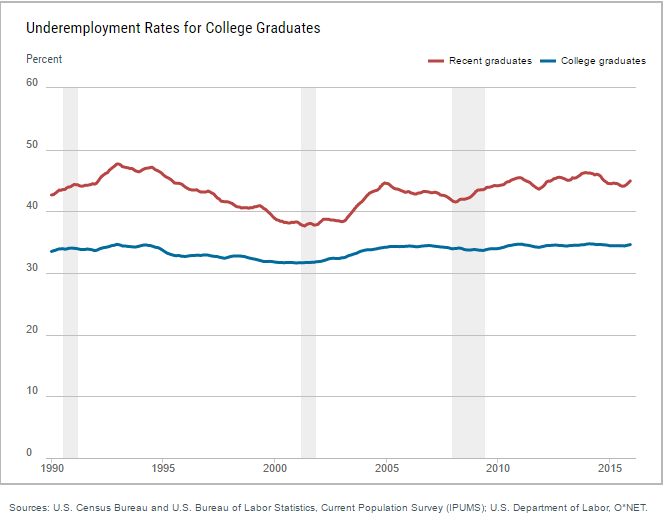
“(NY Fed) The underemployment rate is defined as the share of graduates working in jobs that typically do not require a college degree. A job is classified as a college job if 50 percent or more of the people working in that job indicate that at least a bachelor’s degree is necessary; otherwise, the job is classified as a non-college job. Rates are calculated as a twelve-month moving average. College graduates are those aged 22 to 65 with a bachelor’s degree or higher; recent college graduates are those aged 22 to 27 with a bachelor’s degree or higher. All figures exclude those currently enrolled in school. Shaded areas indicate periods designated recessions by the National Bureau of Economic Research.”
Nearly 50 percent of recent college graduates are working in jobs where a college education isn’t typically required. So that life quest was indeed an expensive one, more so than taking drugs and roaming around in the forest. And the bills are coming due since student loans normally start being sent to graduates six months after graduation.
In Michigan a strip club has angered residents by posting this:

When strip clubs realize that college degrees are ubiquitous and many will struggle to find jobs, we really have to question the price structure of college. And I would argue that there needs to be some vocational aspect of a college education when students are paying so much to attend. This ties into many larger issues like many younger Americans being unable to afford home purchases because they carry on so much college debt. 86% of Millennials through a Housing Pulse survey said that too much debt was an obstacle to owning a home. It is also the case that Millennials that did buy in many cases had help from family.
The underemployment rate is troubling because as the cost of a college education soars beyond the typical inflation rate, the yield in the marketplace isn’t very observable. College tuition is up 145% since 2000:

It should be obvious to anyone that this structure will not last.
via IFTTT
Saturday, April 30, 2016
Has the library outlived its usefulness in the age of Internet? You’d be surprised - disinformation
Link
U.S. institutions of higher education and U.S. local governments are under extraordinary pressure to cut costs and eliminate from institutional or governmental ledgers any expenses whose absence would cause little or no...
The post Has the library outlived its usefulness in the age of Internet? You’d be surprised appeared first on disinformation.
via IFTTT
Tuesday, April 19, 2016
What the great degree rip-off means for graduates: low pay and high debt | Aditya Chakrabortty - The Guardian
Link
I warned that students were being misled and was rebuked but it was true. Ministers owe them and me an apology
A few years back, I got my knuckles rapped by a government minister. In public. It was 2010: David Cameron had just come to power, and he was about to thrust university students into a new regime of higher tuition fees and debt.
Against that backdrop, I’d written a column criticising the way in which both Labour and Conservative governments marketed degrees as being some kind of social-mobility jetpack, zooming their wearers to more money and high-powered jobs. It was no such guarantee, I said, citing among other things Whitehall’s own plunging estimates of how much more graduates earn over a lifetime. Graduates, I said, would “probably end up doing similar work to their school-leaver parents – only with a debilitatingly large debt around their necks”.
Continue reading...via IFTTT
Tuesday, March 15, 2016
Children should learn mainly through play until age of eight, says Lego - The Guardian
Link
Toy company funds research suggesting educational development can be hindered by early formal schooling. So are UK schools getting it wrong?
Parents are squeezing the role of play out of their children’s lives in favour of the three ‘R’s as they try to prepare their offspring for a competitive world, according to the head of Lego’s education charity arm.
A lack of understanding of the value of play is prompting parents and schools alike to reduce it as a priority, says Hanne Rasmussen, head of the Lego Foundation. If parents and governments push children towards numeracy and literacy earlier and earlier, it means they miss out on the early play-based learning that helps to develop creativity, problem-solving and empathy, she says.
Continue reading...via IFTTT
Sunday, March 6, 2016
The results are clear: Homework is damaging to young kids and should be banned until High School - Signs of the Times
Link
"There is no evidence that any amount of homework improves the academic performance of elementary students." This statement, by homework research guru Harris Cooper, of Duke University, is startling to hear, no matter which side of the homework debate you're on. Can it be true that the hours of lost playtime, power struggles and tears are all for naught? That millions of families go through a nightly ritual that doesn't help? Homework is such an accepted practice, it's hard for most adults to even question its value. When you look at the facts, however, here's what you find: Homework has benefits, but its benefits are age dependent. For elementary-aged children, research suggests that studying in class gets superior learning results, while extra schoolwork at home is just . . . extra work. Even in middle school, the relationship between homework and academic success is minimal at best. By the time kids reach high school, homework provides academic benefit, but only in moderation. More than two hours per night is the limit. After that amount, the benefits taper off. "The research is very clear," agrees Etta Kralovec, education professor at the University of Arizona. "There's no benefit at the elementary school level." Before going further, let's dispel the myth that these research results are due to a handful of poorly constructed studies. In fact, it's the opposite. Cooper compiled 120 studies in 1989 and another 60 studies in 2006. This comprehensive analysis of multiple research studies found no evidence of academic benefit at the elementary level. It did, however, find a negative impact on children's attitudes toward school.
via IFTTT
Thursday, March 3, 2016
Netflix Billionaire Reed Hastings' Crusade to Replace Public School Teachers With Computers - AlterNet.org Main RSS Feed
Link

When pondering the best way to transform and improve America’s K-12 public schools, do the ideas that first come to mind include: ditching locally elected school boards? Placing grade-school kids in overcrowded computer labs for hours at a time with unproven software and inexperienced teachers? Telling children from poor homes that test scores are the only results that matter? Or putting high-tech entrepreneurs who have financial stakes in the digital tools being road-tested on students on the private boards running those schools?
These are all cornerstones of the charter school movement that has grown out of Silicon Valley, supported by Microsoft’s Bill Gates, who has spent more than $400 million to promote technology-driven charter schools. And they’re being championed by Netflix founder-CEO Reed Hastings, who just launched a $100 million foundation where he is likely to become one of America’s highest-profile figures pushing this anti-democratic, tech-centric, corporate-inspired vision to recast America’s public schools.
“The underlying mentality that Hastings shares with Gates is that computers revolutionized commerce, revolutionized business, revolutionized manufacturing, so now why can’t computers revolutionize education,” said Anthony Cody, a retired high school teacher from Oakland, Calif. and critic of billionaire-led charter schools and their high-tech takeover of the learning process. “In their minds, it is inevitable that it will. The only question is what will be the delivery method.”
The charter school movement emerged in the 1990s as a way to innovate in individual public schools. But over the last decade the movement has evolved into a franchise-dominated industry, where a tight circle of interrelated for-profit and non-profit players are doing everything they can to privatize public education. Across the country, super wealthy foundations—including the Walmart-backed Walton Family Foundation and the Bill and Melinda Gates Foundation—have put more than $1 billion into creating 6,700 charter schools. Besides Gates, there may be no figure more widely identified with the computers-will-fix-everything mindset than Northern California’s Hastings.
Hastings, 55, has been pushing charters for two decades. Last winter, he made national news when he gave the keynote address to the California Charter Schools Association’s (CCSA) convention and said locally elected school boards were hurting schools and should be replaced by privately run boards, like those at charters. Hastings, an ex-president of the California State Board of Education appointed by a Democratic governor, noted that the public might not buy this anti-democratic conclusion, but encouraged his movement players to look beyond the fact that “school boards have been an iconic part of America for 200 years.”
“The most important thing is that they [charters] constantly get better every year… because they have stable governance—they don’t have an elected school board,” said Hastings—even though that narrative of stability and steady improvement has not proven itself out at charters he’s helped found. Nevertheless, Hastings hammered home a note that’s echoed across both his business career and his life as a charter advocate: that rapid growth is the solution. “What we have to do is to work with school districts to grow steadily,” Hastings said. “The work ahead is really hard because we’re at 8 percent of students in California, whereas in New Orleans they’re at 90 percent, so we have a lot of catchup to do… We have to continue to grow and grow.”
Hastings’ remarks were hardly the first salvo between charter proponents and elected school boards. But coming from one of Silicon Valley’s best-known entrepreneurs, they quickly drew negative reactions, especially because Hastings has aligned himself with one of the most hubris-filled sectors of the charter movement: technology executives who believe the only thing stopping Silicon Valley from saving America’s public schools are clunky school boards, needless government regulation and skeptical lifelong educators.
Hastings’ comments were cynically greeted by the Washington Post’seducation blog, where he was labeled part of the billionaire boy’s club of “Bill Gates, Eli Broad, Mark Zuckerberg, various Waltons… some of the prodigiously wealthy who have decided that they know how public education can be ‘fixed’ and have plowed big money into it,” as the Post's Valerie Strauss wrote. Yet “after billions of their dollars have been spent for pet projects, the real problems facing public schools remain.”
Strauss’ last point is crucial. Hastings’ slap at elected boards, while offensive, wasn’t unique. Gates said the same thing when he extolled “mayoral control” of urban schools. “Instead of having a committee of people, you have that one person,” Gates said, “where we’ve seen the willingness to take on some of the older practices and try new things.” The problem, as Strauss noted, is that many of these “pet projects” have yet to deliver on their hype as a pathway out of poverty for poor kids. The darker reality is that these schools are in fact doubling as product development centers for the fabulously rich and their well-connected associates.
High-Tech Experiments Flounder
Hastings’ track record is a prime example of this pattern in action. He helped launch Rocketship Education, a chain of computer-learning centered schools whose grandiose business plan envisioned educating 1 million students in 50 cities, as many as are educated in New York City, the nation’s largest school district. But as EdWeek.org and the San Jose Mercury News have extensively reported, Rocketship’s ambitious plans badly failed to keep the network's foremost promise: to continue raising student test scores.
The notion that higher test scores are the best way to track student accomplishment is controversial in itself. Many educators argue that there’s far more to learning. Nonetheless, Rocketship believes the best way to educate poor kids is to put 150 young students in front of computers for hours at a time, in large lab classes where there are more technicians than experienced teachers. The curriculum’s emphasis is on correctly answering questions, which, as Education Weekly and the Mercury News reported, created so much pressure on students that many became sick. As Cody notes, this approach minimizes what traditional teachers believe is necessary—the transmission of developmentally appropriate interpretation, communication and social skills, as well as paying personal attention to students whose home lives may be filled with factors complicating their ability to learn.
Yet Rocketship and the software firms plying this “blended learning” experiment has been one of Hastings' priorites. Last winter, he donated $2 million to start a $17 million fundraising drive for the chain. Reality, however, took hold last spring as the chain's student test scores “plummeted,” as the Mercury News put it. There was also teacher burn-out, fear among non-unionized faculty of criticizing the curriculum, and raised eyebrows after the chain’s founder left to create a software firm that sold its wares back to Rocketship—an organization supported by taxpayers and philanthropy. Rocketship postponed expansion plans in Texas, and even Hastings spoke about taking a pause to figure out what was wrong and how to keep growing.
“Rocketship sort of assumed they could work with existing hardware and software,” Cody explained, referring to the learning tools and answer-oriented agenda put before students. “At Rocketship, kids are three hours a day in a computer lab with 150 students in a room, two to three lab techs, and one 'teacher' that supervises the whole thing… They describe what they do as personalizing the learning experience.”
It’s not surprising that the founder of Netflix would find putting kids in front of digital devices that track what they are doing and relying on software formulas to tell them what they need to do next, an attractive educational strategy. It many respects, device-centered tracking and user analysis is what Silicon Valley has developed to trace consumer-buying patterns. In the public school world, tracking test scores—Bill Gates’ emphasis—has become the coin of the realm, largely because it is faster and can be done more easily on a large scale than assessing other indices of learning that are not metric-centered, but track other ways children gain intellectual and life skills.
Rocketship is not the only example of a Hastings project that exposes the problematic nature of tech-centric learning. Many studies—including a trio released last fall and funded by the pro-charter Walton Family Foundation—have found that most of the kids in cyber-centered learning environments fall drastically behind their brick-and-mortar peers. Khan Academy, which has been backed by Hastings, produces online videos on math problems. Even though it has been a viral sensation, experienced teachers have called it sloppy and imprecise.
These initiatives are emblematic of the corner of the charter school world that Hastings inhabits. Like Gates’ support of test-centered curriculum, there are Silicon Valley biases and imperatives driving them. One is that digital data can replace the judgments and knowledge of experienced teachers. The other is that reducing the ratio of teachers to students, which cuts personnel costs (and feeds the mindset that there’s big money to be made in privatizing public education), is of no consequence to student learning. It’s hardly news that entrepreneurs see profits in developing online tools, even if it may be years before their effectiveness can be assessed—such as by seeing how cyber-schooled kids fare once they enroll in colleges and universities.
Outsider, Entrepreneur, Democrat
Hastings didn’t begin his career as an education reformer by trashing school boards and pushing tech-centric solutions that can scale. But tracing his involvement in California’s education reform movement for the past two decades reveals what brought him there.
People who know him describe him as a quasi-liberal, an ex-Peace Corp volunteer who taught in Africa and then came back and made several fortunes as a math whiz, computer programmer and tech entrepreneur. They see him as an idealist who has given millions to bankroll state ballot measures and candidates who share his vision—particularly with charter schools. But his business experience and successes have shaped him over the years and led to a growing hubris that’s all too common among high-tech executives—the belief the world be a better place if only it could be more like them.
Hastings, who lives in the counterculture-embracing coastal town of Santa Cruz, has always played by his own rules. Today, he comes across as a mild-mannered, graying, goateed man in his mid-50s who prides himself on trusting his intuition and following up with hard work. Decades ago, Fortune magazine said “he was as hard-headed as they come. So much so that he earned the nickname ‘animal.’”
He grew up in suburban Boston, went to liberal arts college in Maine where he majored in math and ran the outdoors club, and after a bad experience in a Marine Corps officer-training program, joined the Peace Corps and was sent to Swaziland to teach math. He then went to Stanford University, where he earned a computer science degree. Afterward, he created a company that made software tools for Unix developers called Pure, which was bought for $750 million in 1997—his first fortune. He soon left and enrolled in another masters program at Stanford, in education, and got involved in California politics.
In 1998, he teamed up with education experts he met at Stanford to write a state ballot measure to repeal a cap on the number of charter schools that could open across California in one year. The state’s charter law, passed in 1992, allowed 100 schools to open annually and not more than 10 per school district. After paid circulators got the signatures needed to get the measure on the ballot, the legislature stepped in and passed a bill lifting the cap. The same year, Hastings became the CEO of TechNet, a new Silicon Valley lobbying group whose members were all CEOs who also backed federal candidates from both parties. Here, he again saw how money, power and influence converge and could bring about political results.
In 2000, Hastings took aim at another statewide reform—lowering the vote needed, from two-thirds to 55 percent, to pass school bonds. Hastings gave $1 million to Proposition 39, which passed, delighting the state’s teachers unions. That year, Democratic Gov. Gray Davis appointed Hastings to the state Board of Education, where he became president in 2001. Among their issues was how to test students’ progress. In 2004, he was nominated for another term by then-Republican Gov. Arnold Schwarzenegger. Democrats blocked him in response to his support for teaching 2.5 hours a day of English in bilingual kindergartens (previously 90 percent of the instruction was in Spanish). “I lacked political deftness,” he told a pro-charter website last year.
Hastings shifted his focus to a new business, Netflix, the idea for which came after being charged a late fee at a video store. But he was a steady and reliable donor to state and federal candidates, usually Democrats, and to education-based campaigns in California. Many of his candidates did not win, reporters tracking the state’s biggest donors found. By 2005, Hastings was not just a dedicated supporter of charters, but was saying that public education’s future depended on schools being run like private corporations.
“If public schools don’t adopt the same principles of competition and accountability as exist in the private and nonprofit sectors, they will continue to deteriorate,” he said in 2005, explaining his philosophy on the New School Venture Fund website, a Silicon Valley grant-making hub he helped to create that has invested in charters and education software. “More and more parents with means will send their children to private schools, and the institution will become like Medicare, an alternative for only the most disadvantaged.” (Medicare is the federal government’s popular health plan for people 65 and older; in early 2016 it had 49.5 million recipients.)
Hastings also complained that even though his world was “littered” with business people who wanted to help the situation, he saw no overarching plan to improve K-12 schools, apart from supporting new charters. “One way to permanently impact the system would be to have 10 to 20 percent of California schoolchildren enrolled in charter schools,” he said in 2005, foreshadowing his own advocacy. “That would be critical mass, and enough of a force to induce a competitive dynamic in the system.”
The Million-Dollar Check Writer
It wasn’t unusual for Hastings to write quarter-million dollar checks, or more, to campaigns and causes. In 2014, he gave $247,000 to a successful state ballot measure that rolled back sentences for non-violent crimes. In 2012, he gave $1 million to support a successful ballot measure drafted by Gov. Jerry Brown to raise taxes on the wealthiest Californians. That year he also gave $250,000 to a failed measure to end the state’s death penalty. But his top priority has primarily been charter schools and computer-centered learning.
In 2014, Hastings gave $1.5 million to the California Charter Schools Association Advocates, which, as the Los Angeles Times wrote, “transferred much of the money to an affiliated political action committee that supported candidates in the 2015 Los Angeles Board of Education elections,” where there was a big fight brewing over how quickly charter schools could expand in L.A., the nation’s second largest school district. Another billionaire, Eli Broad, had floated a plan to turn half of the city’s schools into charters in eight years; just last month, the L.A. school board soundly rejected that proposal.
More recently, Hastings has increased his support for educational software developers. As the pro-charter EducationNext.org explained in a profile last winter, “Netflix CEO Reed Hastings has given millions of dollars to start charter schools. He’s put millions more into developing education software to personalize learning.... And he is not a fan of school boards.” The article continues, showing the small and entwined world of charter operators and elite high-tech businesses:
“Hastings provided start-up funding for the Aspire Public Schools charter network and helped start and fund EdVoice, a lobbying group, and the NewSchools Venture Fund, which supports education entrepreneurs. He’s given money to Sal Khan of Khan Academy to develop teaching videos—and a dashboard to track student progress—used in the U.S. and around the world. Hastings also supports Rocketship Education, which blends adaptive learning on computers with teacher-led instruction. He’s on the board of the California Charter Schools Association; the KIPP Foundation; DreamBox Learning, an education technology company; and the Pahara Institute, which provides fellowships to education leaders.”
Hastings' announcement in January that he was creating a $100 million foundation to focus on education suggests he will not only keep doing what he has been doing—as exemplified by his support of Rocketship and software firms putting largely untested ideas in charter schools—but also step up the pace. Last winter, he told a pro-charter website that one takeaway from the Rocketship turmoil of falling test scores was that software was best for teaching “subjects with correct answers,” but “it will take 5 to 10 years of hard work to figure out” how to use it to teach an interpretive subject like history or literature.
It’s worth pondering that comment. Rocketship has plans to keep on expanding into new states and opening more schools in low-income communities. Hastings’ $100 million donation undoubtedly will allow this and related experiments to continue and grow, whether or not device-centered classrooms in charter schools will prove to help or hurt students. Last fall, Hastings affirmed his long game philosophy: because he’s a billionaire, he can impose pet projects on public schools.
“The key in management is you have to have your long-term, stable, successful picture. And motivate people—employees, suppliers, investors toward that picture,” Hastings told CNBC. “There will be uneven amounts of execution toward it, potentially doubts at times if it’s achievable. But you can’t get concerned.”
Related Stories
- National Poll Finds Overwhelming Bipartisan Support to Rein in Charter School Lapses
- National Poll Finds Overwhelming Bipartisan Support to Reign in Charter School Lapses
- New York City Moves to Shutter Three Charter Schools, Including One of Its Oldest
via IFTTT
Wednesday, March 2, 2016
How Billionaires Use Non-Profits to Bypass Governments and Force Their Agendas on Humanity - AlterNet.org Main RSS Feed
Link

As wealth becomes concentrated in fewer and fewer hands, the billionaire class is increasingly turning to foundations and non-profits to enact the change they would like to see in the world. Amid the rise of philanthrocapitalism, growing numbers of critics are raising serious questions about whether this outsized influence is doing more harm than good.
In the January issue of the New York Review of Books, veteran journalist Michael Massing noted that, in the past 15 years alone, “the number of foundations with a billion dollars or more in assets has doubled, to more than eighty.” The philanthropic sector in the United States is far more significant than in Europe, fueled in part by generous tax write-offs, which the U.S. public subsidizes to the tune of $40 billion a year.
As Massing observes, billionaires are not just handing over their money, they have ideas about how it should be used, and their vision often aligns with their own economic interests. For this reason, the philanthropy industry deserves rigorous scrutiny, not a free pass because it is in the service of good.
Massing’s argument followed a study released in January by the watchdog organization Global Policy Forum, which found that philanthropic foundations are so powerful they are allowing wealthy individuals to bypass governments and international bodies like the United Nations in pursuit of their own agendas. What’s more, this outsized influence is concentrated in the United States, where 19 out of the top 27 largest foundations are based. These 27 foundations together possess $360 billion, write authors Jens Martens and Karolin Seitz.
Such dramatic wealth accumulation has disturbing implications. "What is the impact of framing the problems and defining development solutions by applying the business logic of profit-making institutions to philanthropic activities, for instance by results-based management or the focus on technological quick-win solutions in the sectors of health and agriculture?" the report asks.
These questions are not new, as social movements have long raised the alarm about the global impact of the ever-expanding philanthropy sector. In 2010, the international peasant movement La Via Campesina blasted the Bill and Melinda Gates Foundation’s acquisition of Monsanto shares as proof that its role in privatizing the global food supply and exporting big agribusiness, from Africa to North America, should be viewed through a commercial rather than humanitarian lens.
“It is really shocking for the peasant organizations and social movements in Haiti to learn about the decision of the [Gates] Foundation to buy Monsanto shares while it is giving money for agricultural projects in Haiti that promote the company’s seed and agrochemicals,” said Chavannes Jean-Baptiste of the Haitian Peasant Movement of Papaye and Caribbean coordinator of La Via Campesina at the time. “The peasant organizations in Haiti want to denounce this policy which is against the interests of 80 percent of the Haitian population, and is against peasant agriculture—the base of Haiti’s food production.”
The Gates Foundation more recently fell under scrutiny from the advocacy organization Global Justice Now, which released a report in January raising concerns about the institution’s track record on education, food and health care policies.
“The Gates Foundation has rapidly become the most influential actor in the world of global health and agricultural policies, but there’s no oversight or accountability in how that influence is managed,” said Polly Jones of Global Justice Now. “This concentration of power and influence is even more problematic when you consider that the philanthropic vision of the Gates Foundation seems to be largely based on the values of corporate America. The foundation is relentlessly promoting big business-based initiatives such as industrial agriculture, private health care and education. But these are all potentially exacerbating the problems of poverty and lack of access to basic resources that the foundation is supposed to be alleviating.”
Facebook CEO Mark Zuckerberg and his wife, Priscilla Chan, raised eyebrows in December when they announced they would give away 99 percent of their wealth. As it turned out, this was not a giveaway at all, but a shifting of funds into their own limited liability company (LLC). Just weeks later, Zuckerberg lashed out at Indian media justice advocates who raised concerns about his company’s efforts to undermine net neutrality protections in their country.
Like many others, Massing is calling for greater transparency, not only for foundations but for think tanks, Hollywood, Silicon Valley and universities. Pointing to the website Inside Philanthropy, whose stated purpose is to “pull back the curtain on one of the most powerful and dynamic forces shaping society,” Massing argues that far greater and better-resourced scrutiny is needed. “There remains the question of how to pay for all this,” writes Massing, posing: “Is there perhaps a consortium of donors out there willing to fund an operation that would part the curtains on its own world?”
But some argue that we already have all the information we need to be concerned. In December, Vandana Shiva, an ecofeminist and activist, wrote in response to Zuckerberg’s move in India that a “collective corporate assault is underway globally. Having lined up all their ducks, veterans of corporate America such as Bill Gates are being joined by the next wave of philanthro-corporate Imperialists, including Mark Zuckerberg.”
“It is an enclosure of the commons,” she continued, “which are ‘commons’ because they guarantee access to the commoner, whether it be seed, water, information or internet.”
Related Stories
- The Best and Worst States for Women in America, From Wages to Life Expectancy
- These Are the Best and Worst States for Women in America, From Wages to Life Expectancy
- Los Angeles Cracking Down on 'Tiny Houses' Donated to Homeless for Safe Place to Sleep
via IFTTT
Monday, February 29, 2016
William Doyle: What Makes Finnish Schools So Successful? - Diane Ravitch's blog
Link
William Doyle recently returned from a Fulbright year in Finland, and he spent his year studying education. His own child attended a Finnish school. He wrote about some of the lessons he learned in this article that appeared in the Hechinger Report. Here is the big takeaway: If you want results, try […]

via IFTTT
Thursday, February 18, 2016
Amazon's Plans for OER - Hack Education
Link
But it doesn’t appear as though Amazon Inspire is about enabling schools or educators to spin up their own infrastructure to publish, host, and share content. It’s about building a marketplace, controlled by Amazon, to buy, sell, and trade stuff. This is Amazon.com for education, not AWS. And that’s a pity, because rethinking some of the infrastructure of an educational Web – something that Caulfield has been writing about lately – is far more interesting than building yet another centralized and corporatized OER repository.
via IFTTT
Tuesday, January 19, 2016
Technology Integration in Districts and Schools: Next Project (Part 1) - Larry Cuban on School Reform and Classroom Practice
Link
For decades, as a teacher, administrator, and researcher I have been a consumer and a skeptic of new technologies in both K-12 schools and higher education. My books, articles, talks, and this blog have documented the hype, adoption, and partial … Continue reading →

via IFTTT
Tuesday, December 15, 2015
Mike Rowe to Bernie Sanders: Stop Telling Everyone College is The Only Thing - Reason.com Full Feed
Friday, October 30, 2015
Dragged Across the Classroom Floor: It’s Time to Admit That Schools Are Prisons - The Anti-Media
Link
Here's why.
The post Dragged Across the Classroom Floor: It’s Time to Admit That Schools Are Prisons appeared first on The Anti-Media.
via IFTTT
Thursday, October 29, 2015
The Dismal Failure of Arne Duncan's 'Race to the Top' Program - AlterNet.org Main RSS Feed
Link

Sometimes events happen that seem to be disconnected, but after a few days or weeks, the pattern emerges. Consider this: On October 2, Secretary of Education Arne Duncan announced that he was resigning and planned to return to Chicago. Former New York Commissioner of Education John King, who is a clone of Duncan in terms of his belief in testing and charter schools, was designated to take Duncan’s place. On October 23, the Obama administration held a surprise news conference to declare that testing was out of control and should be reduced to not more than 2 percent of classroom time. Actually, that wasn’t a true reduction, because 2 percent translates into between 18-24 hours of testing, which is a staggering amount of annual testing for children in grades 3-8 and not different from the status quo in most states.
Disconnected events?
Not at all. Here comes the pattern-maker: the federal tests called the National Assessment of Educational Progress released its every-other-year report card in reading and math, and the results were dismal. There would be many excuses offered, many rationales, but the bottom line: the NAEP scores are an embarrassment to the Obama administration (and the George W. Bush administration that preceded it).
For nearly 15 years, Presidents Bush and Obama and the Congress have bet billions of dollars—both federal and state– on a strategy of testing, accountability, and choice. They believed that if every student was tested in reading and mathematics every year from grades 3 to 8, test scores would go up and up. In those schools where test scores did not go up, the principals and teachers would be fired and replaced. Where scores didn’t go up for five years in a row, the schools would be closed. Thousands of educators were fired, and thousands of public schools were closed, based on the theory that sticks and carrots, rewards and punishments, would improve education.
But the 2015 NAEP scores released today by the National Assessment Governing Board (a federal agency) showed that Arne Duncan’s $4.35 billion Race to the Top program had flopped. It also showed that George W. Bush’s No Child Left Behind was as phony as the “Texas education miracle” of 2000, which Bush touted as proof of his education credentials.
NAEP is an audit test. It is given every other year to samples of students in every state and in about 20 urban districts. No one can prepare for it, and no one gets a grade. NAEP measures the rise or fall of average scores for states in fourth grade and eighth grade in reading and math and reports them by race, gender, disability status, English language ability, economic status, and a variety of other measures.
The 2015 NAEP scores showed no gains nationally in either grade in either subject. In mathematics, scores declined in both grades, compared to 2013. In reading, scores were flat in grade 4 and lower in grade 8. Usually the Secretary of Education presides at a press conference where he points with pride to increases in certain grades or in certain states. Two years ago, Arne Duncan boasted about the gains made in Tennessee, which had won $500 million in Duncan’s Race to the Top competition. This year, Duncan had nothing to boast about.
In his Race to the Top program, Duncan made testing the primary purpose of education. Scores had to go up every year, because the entire nation was “racing to the top.” Only 12 states won a share of the $4.35 billion that Duncan was given by Congress: Tennessee and Delaware were first to win, in 2010. The next round, the following states won multi-millions of federal dollars to double down on testing: Maryland, Massachusetts, the District of Columbia, Florida, Georgia, Hawaii, New York, North Carolina, Ohio, and Rhode Island.
Tennessee, Duncan’s showcase state in 2013, made no gains in reading or mathematics, neither in fourth grade or eighth grade. The black-white test score gap was as large in 2015 as it had been in 1998, before either NCLB or the Race to the Top.
The results in mathematics were bleak across the nation, in both grades 4 and 8. The declines nationally were only 1 or 2 points, but they were significant in a national assessment on the scale of NAEP.
In fourth-grade mathematics, the only jurisdictions to report gains were the District of Columbia, Mississippi, and the Department of Defense schools. Sixteen states had significant declines in their math scores, and thirty-three were flat in relation to 2013 scores. The scores in Tennessee (the $500 million winner) were flat.
In eighth grade, the lack of progress in mathematics was universal. Twenty-two states had significantly lower scores than in 2013, while 30 states or jurisdictions had flat scores. Pennsylvania, Kansas, and Florida (a Race to the Top winner), were the biggest losers, by dropping six points. Among the states that declined by four points were Race to the Top winners Ohio, North Carolina, and Massachusetts. Maryland, Hawaii, New York, and the District of Columbia lost two points. The scores in Tennessee were flat.
The District of Columbia made gains in fourth grade reading and mathematics, but not in eighth grade. It continues to have the largest score gap—56 points–between white and black students of any urban district in the nation. That is more than double the average of the other 20 urban districts. The state with the biggest achievement gap between black and white students is Wisconsin; it is also the state where black students have the lowest scores, lower even than their peers in states like Mississippi and South Carolina. Wisconsin has invested heavily in vouchers and charter schools, which Governor Scott Walker intends to increase.
The best single word to describe NAEP 2015 is stagnation. Contrary to President George W. Bush’s law, many children have been left behind by the strategy of test-and-punish. Contrary to the Obama administration’s Race to the Top program, the mindless reliance on standardized testing has not brought us closer to some mythical “Top.”
No wonder Arne Duncan is leaving Washington. There is nothing to boast about, and the next set of NAEP results won’t be published until 2017. The program that he claimed would transform American education has not raised test scores, but has demoralized educators and created teacher shortages. Disgusted with the testing regime, experienced teachers leave and enrollments in teacher education programs fall. One can only dream about what the Obama administration might have accomplished had it spent that $5 billion in discretionary dollars to encourage states and districts to develop and implement realistic plans for desegregation their schools, or had they invested the same amount of money in the arts.
The past dozen or so years have been a time when “reformers” like Arne Duncan, Michelle Rhee, Joel Klein, and Bill Gates proudly claimed that they were disrupting school systems and destroying the status quo. Now the “reformers” have become the status quo, and we have learned that disruption is not good for children or education.
Time is running out for this administration, and it is not likely that there will be any meaningful change of course in education policy. One can only hope that the next administration learns important lessons from the squandered resources and failure of NCLB and Race to the Top.
Related Stories
- The Problem with Obama's New Testing Plan? It's Terrible, and It Changes Absolutely Nothing
- For Two Sharply Divided Manhattan Schools, an Uncertain Path to Integration
- The Brazen Ways the Charter School Industry Rips You Off
via IFTTT